You've heard it before: cut down on blue light, enable night mode, stay off screens before bed. But what if the real problem isn't what LED lighting contains — it's what it leaves out?
Emerging research is shifting the conversation. The issue may not be blue light overexposure. It may be spectral imbalance — and the biological consequences of a light diet that's quietly incomplete.
Most modern LED lighting is engineered for efficiency and visual performance. To achieve this, LEDs concentrate energy within the visible spectrum — roughly 350–650nm — with a pronounced peak around 420–450nm (blue wavelengths).
For the eye, this works well. The human visual system is highly sensitive to these wavelengths, so less energy achieves greater perceived brightness. LEDs tick every conventional box: brightness, color temperature, color rendering index (CRI).
But here's the catch: meeting visual standards doesn't mean meeting biological ones.
In controlled studies, individuals exposed to standard LED lighting showed measurable improvements in visual performance when broader-spectrum light was introduced — even when brightness stayed exactly the same. The variable wasn't lux. It was spectrum.
To understand the gap, look beyond what the eye can see.
Natural daylight spans roughly 300–2500nm — a continuous range that includes not just visible light, but also near-infrared wavelengths. Traditional incandescent bulbs share a similar broad, continuous output.
Standard LEDs, by contrast, are spectrally narrow. Most emit little to nothing beyond 700nm.
In modern offices and homes with limited natural daylight exposure, this creates a situation where people spend most of their waking hours under light that's missing an entire portion of the natural spectrum. That absence may carry biological weight.
Light doesn't just help us see — it interacts with the body at a cellular level.
At the center of this interaction are mitochondria, the structures responsible for producing cellular energy (ATP). Their efficiency influences everything from metabolism to visual function to how we feel at the end of a long workday.
Research suggests different wavelengths affect mitochondrial activity in distinct ways:
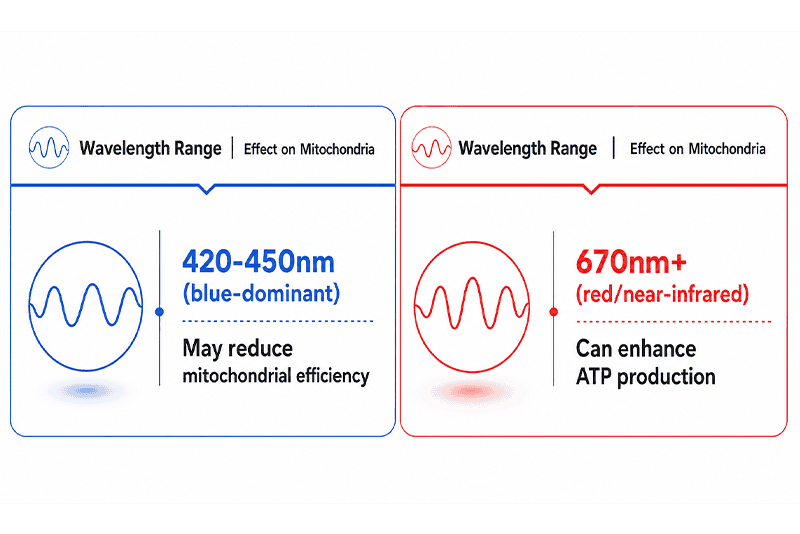
The retina is particularly relevant here — it's one of the most metabolically demanding tissues in the body. In a recent workplace study, introducing broader-spectrum light with longer wavelengths led to approximately 25% improvement in color contrast sensitivity, with effects persisting for several weeks after exposure.
This suggests lighting doesn't only influence vision in real time. It may be shaping underlying biological processes over the long term.
This is where it gets nuanced.
Blue light is not inherently harmful. It plays a legitimate and necessary role: regulating alertness, supporting circadian timing, and enabling daytime visual performance. The issue arises when blue wavelengths dominate in isolation — without the counterbalancing presence of longer wavelengths.
Think of it like nutrition. Carbohydrates aren't the enemy. An unbalanced diet is.
We've optimized LED lighting for how the eye perceives brightness. We haven't fully optimized for how the body responds to light. The result is a lighting environment that looks fine by every measured standard — and still leaves something out.
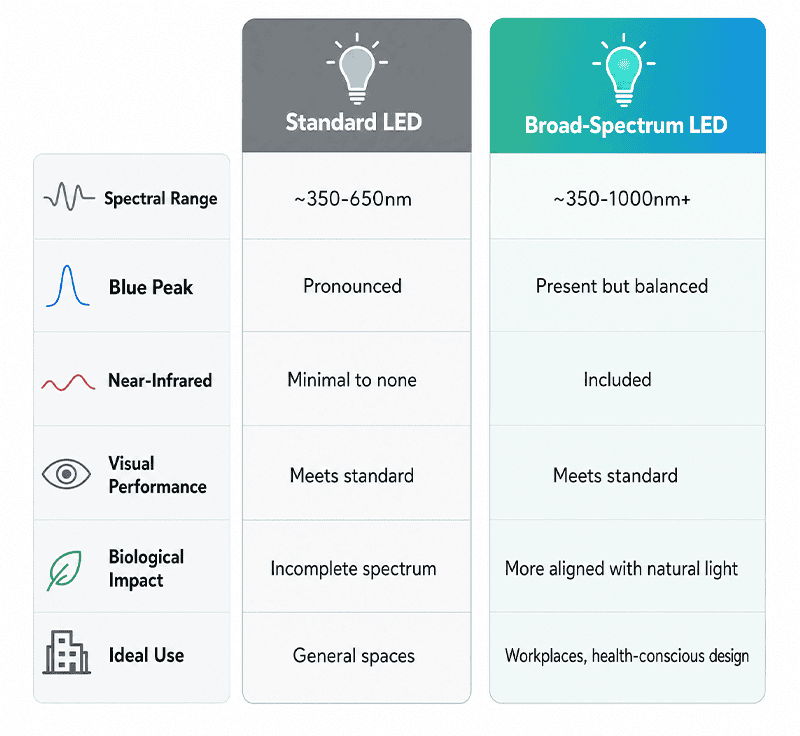
LED technology itself is not the limitation — it is the foundation of modern lighting design. The advantages in efficiency, lifespan, and flexibility are undeniable.
The next step in lighting evolution is not replacement, but refinement.
Emerging directions include:
This reflects a broader shift in lighting design: from “what we see” toward “how light affects us.”
For a deeper exploration of how different color temperatures influence emotional response and productivity, you can read this related article: 3000K vs 6000K Light Color: Make You Anxious or Productive.

