For decades, office lighting standards have focused on one primary metric: lux.
If a workspace delivers 500, 750, or even 1000 lux, it is generally considered “well-lit.” But what if brightness is not the real issue?
Emerging research published in Scientific Reports suggests that modern LED lighting — even at high brightness levels — may be missing a critical component of human-centered illumination: a biologically complete spectrum. So the question is no longer “Is it bright enough?” It’s becoming: Is the spectrum right?
In many modern offices, lighting easily reaches 1000 lux at desk height — well above minimum requirements. From a visual engineering perspective, that should be more than sufficient.
However, a recent controlled workplace study showed something unexpected. Participants working under standard LED lighting (around 1000 lux, 4000K, high color fidelity) experienced measurable improvements in color contrast sensitivity when their environment was supplemented with broader-spectrum light containing near-infrared wavelengths. Brightness did not change significantly. The spectrum did.
The result? Visual performance improved by approximately 25% — and the improvement lasted weeks after the broader-spectrum exposure ended.
This suggests that lux alone does not define visual performance.
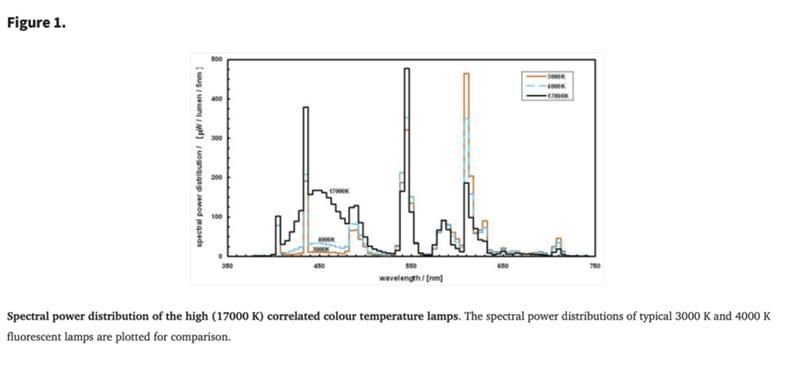
Most commercial LEDs emit light primarily between 350–650nm, with a strong peak in the blue range (420–450nm).
This works well for visual perception because the human eye is most sensitive within the visible range (roughly 400–700nm). From an energy-efficiency standpoint, this makes sense.
But sunlight — the light under which human biology evolved — spans approximately 300–2500nm, extending well into the near-infrared range.
Modern offices, sealed behind infrared-blocking glazing and illuminated exclusively by LEDs, often contain virtually no near-infrared light.
And that may matter more than previously thought.
The key lies in mitochondria — the cellular structures responsible for producing ATP, the energy currency of the body.
Research across multiple species has shown:
• Short-wavelength dominant light (especially 420–450nm) can suppress mitochondrial function.
• Longer wavelengths, particularly in the 670–900nm range, enhance mitochondrial respiration and ATP production.
The retina is one of the most metabolically active tissues in the human body. When mitochondrial efficiency improves, visual performance improves.
In the workplace study, adding broad-spectrum light similar to incandescent or daylight conditions resulted in balanced improvements in both red and blue contrast sensitivity — unlike previous narrow-band interventions that favored only specific visual channels.
Even more interesting: the improvements were sustained for up to six weeks.
This suggests we are not simply observing a temporary visual effect — but a metabolic shift.
Not necessarily. LED technology has transformed energy efficiency, reduced operational costs, and enabled advanced lighting control systems.
The issue is not LED itself — but its spectral narrowness. Standard LED design optimizes for visible light efficiency, not biological completeness.
In other words: We engineered lighting around what the eye sees —
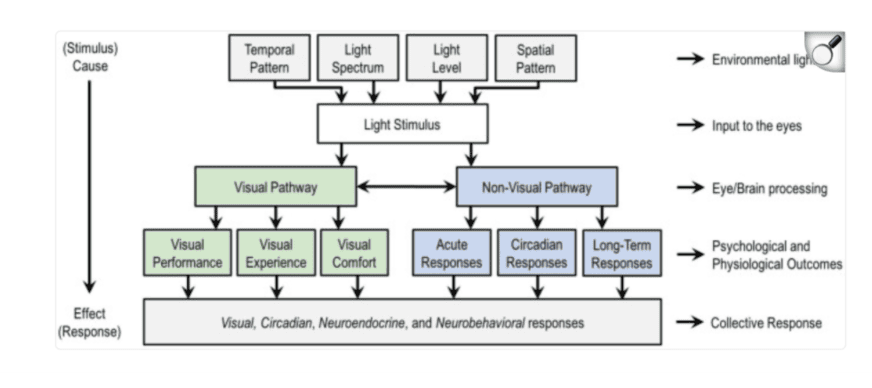
but not necessarily around how the body responds. As office design increasingly focuses on employee well-being, cognitive performance, and long-term productivity, spectrum may become as important as brightness, glare control, and color rendering.
Probably not.
Traditional incandescent lighting contains a continuous spectrum with near-infrared components, but it is energy-inefficient and being phased out globally.
The real opportunity lies elsewhere:
• Multi-channel spectral LED systems
• Hybrid lighting that integrates controlled near-infrared components
• Tunable spectral architecture in smart buildings
• Task-level infrared supplementation in performance-critical zones
Future-ready office lighting may not simply adjust intensity or color temperature — it may dynamically manage spectrum.
For architects, lighting designers, and facility managers, this research reframes a key question:
Instead of asking:
“How many lux do we need?”
We may need to ask:
“What spectrum are we delivering?”
Forward-thinking workplace strategies could begin exploring:
• Spectrum analysis alongside lux measurement
• Consideration of infrared presence in deep-plan offices
• Integration of broader-spectrum lighting in high-performance environments
• Collaboration between lighting engineers and building wellness consultants
As buildings become smarter and more data-driven, spectral quality may become a measurable performance metric — not just a technical detail.
The conversation around human-centric lighting has largely focused on circadian rhythm and color temperature (CCT).
But this research suggests another dimension:
mitochondrial interaction with light.
If validated at scale, this could shift office lighting design toward a more biologically integrated approach — one that acknowledges light as both a visual and metabolic stimulus.
Front Neurol. 2021 Jan 27;12:630553. doi: 10.3389/fneur.2021.630553
J Circadian Rhythms. 2007 Jan 11;5:2. doi: 10.1186/1740-3391-5-2

