
 Tiéng ViêtVNTiéng ViêtVN
Walk into any well-designed hotel in Singapore and the lighting never feels like one decision. The lobby glows warm around the greenery. Guest rooms shift from bright morning light to a soft evening haze. A banquet hall transforms between conference and wedding dinner in minutes.
That's layered lighting — and for hotel projects in Singapore, where rooms are compact, BCA Green Mark drives energy targets, and guest expectations run high, it's the difference between a space guests photograph and one they forget.
Hotel lobbies in Singapore increasingly lean on biophilic design — living walls, indoor planting, water features. Greenery only looks lush under high-CRI light; aim for CRI 90 and above with strong red rendering (R9). Most lobbies land at 2700K–3000K, layered across ambient, accent, and task zones.
Guest rooms face the opposite challenge: compact footprints. The solution is vertical light — wall-washing, cove lighting, and headboard-mounted reading fixtures that draw the eye up. For general and bedside lighting, 2700K–3000K dominates. A recessed downlight with anti-glare optics and full metal construction keeps ceilings clean while maintaining CRI 90 across 9W to 40W options — practical when specifying an entire floor plate.
On colour temperature and mood, research suggests that warmer evening light helps the body wind down while cooler daylight tones support alertness — a consideration when guests are recovering from long-haul flights.
Guest corridors should feel like a continuation of the guest experience — 3000K, gentle, and uniform. In practice, corridors and public transition spaces often suit a modular linear fixture that can be spliced and extended for long runs, with an opal diffuser that eliminates hot spots and a no-flicker driver design suited to 24-hour operation.
Staff areas, kitchens, and service corridors are where energy savings earn their keep — and where CCT shifts to 4000K for task visibility. For service corridors and plant rooms, a high-efficacy LED batten at up to 145 lm/W with a robust steel body and opal diffuser handles the demands of continuous use.
Where ceiling heights climb — loading docks, parking structures, large plant rooms — an IP65-rated LED highbay delivering up to 180 lm/W with Zhaga-compatible sensor readiness brings adaptive control to spaces that would otherwise burn energy around the clock. Back-of-house spaces also benefit from keeping glare under control — low UGR values support visual comfort during long shifts, particularly in kitchens and laundry areas where staff work extended hours under artificial light. Occupancy sensing in low-traffic service corridors can cut energy use substantially and contributes directly toward BCA Green Mark points.
The hotel entrance — driveway canopy, porte-cochère, facade — is the guest's first physical touchpoint after the booking screen. A weather-sealed floodlight with IP66 rating and precision beam control handles Singapore's tropical rain while making the building read clearly from the street at night.
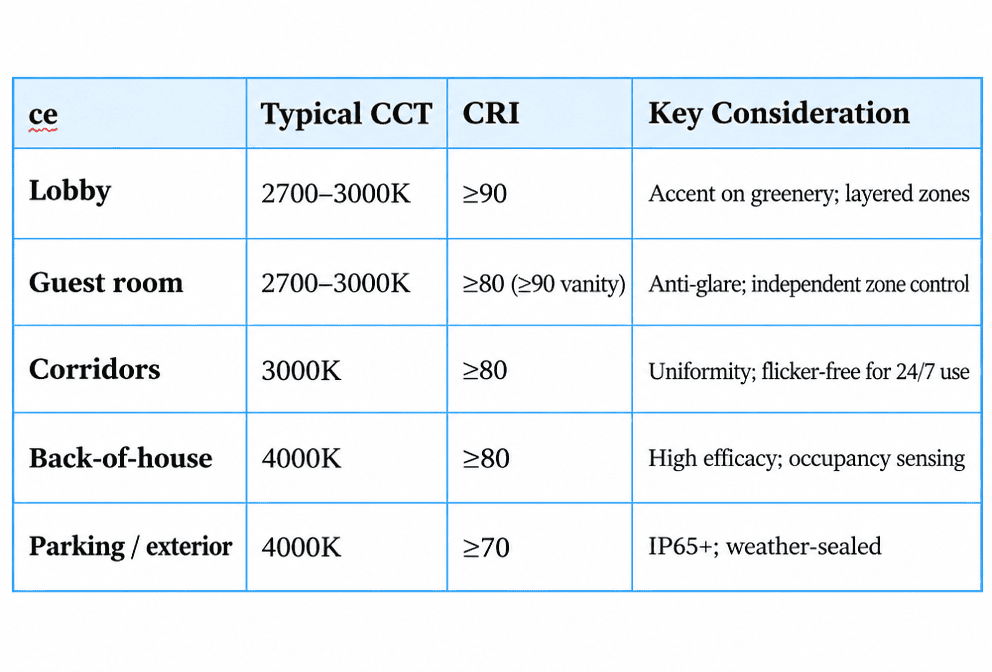
2700K–3000K is the near-universal choice. Warm light signals relaxation and pairs naturally with wood tones and textile finishes common in hotel interiors.
Guest rooms and F&B spaces benefit most from dimming — ideally down to 10% or lower. Back-of-house and corridor lighting can often run fixed-output, though occupancy sensing still delivers strong energy savings.
CRI 90 or above for all guest-facing areas — lobbies, rooms, restaurants, vanity mirrors. Back-of-house can operate at CRI 80. The difference shows most vividly on skin tones, food, and greenery.