You know the feeling — you turn off the overhead light, lie in the dark, and still can't fall asleep. You've tried the usual fixes: no caffeine after 3pm, white noise, blackout curtains. But there's one factor most people overlook: the color temperature of the light you were under in the hours before bed.
Here's the thing: simply swapping to a warm bulb isn't enough. Sleep-friendly bedroom lighting isn't about one perfect color temperature — it's about how your lighting transitions through the evening. That gradual shift from functional brightness to soft, low-level warmth is what helps your body wind down.
Let's look at why 2700K and 3000K both have a role, and how to use them together.
Light doesn't just help you see — it influences your body's internal timing. Research on circadian rhythms consistently shows that warm, amber-toned light (2700K–3000K) has a much milder effect on alertness than cool, blue-heavy light (4000K–6500K). That's why the warm end of the spectrum is generally recommended for evening environments.
But color temperature is only one piece. Brightness, timing, and where the light sits in the room all work together. A 2700K bulb at full brightness overhead is still not ideal at 11pm. The best bedroom lighting combines the right warmth with the right intensity at the right time.

Both sit on the warm end of the spectrum, but they serve slightly different roles in the evening.
2700K (Extra Warm White) has a deep amber tone, similar to a candle flame or a classic incandescent bulb. It's the warmer of the two and well-suited to the final hour before sleep — think bedside reading lamps or soft accent lighting when you're already winding down.
3000K (Warm White) is slightly whiter while still feeling relaxed. It gives enough visual clarity to get dressed, tidy up, or read without strain. For most people, 3000K works better as the general bedroom color temperature earlier in the evening, when you still need functional light.
Which one to choose? If you're picking a single color temperature for the whole room, 3000K is the more versatile option — warm enough for winding down, bright enough for evening tasks. But the real advantage comes from using both: 3000K as your base layer, and 2700K as your wind-down layer closer to bedtime. For a deeper look at how color temperatures affect your mood and alertness throughout the day, see our breakdown of 3000K vs 6000K lighting.
This is where most bedroom lighting setups fall short. People buy a single warm bulb, install it, and expect it to handle everything from getting ready at 8pm to falling asleep at 11pm.
But your body doesn't switch from "awake" to "asleep" in one moment. The wind-down process takes hours — and your lighting should follow that same gradual curve. A fixed warm bulb at full brightness all evening is better than cool white, but it still misses the bigger picture.
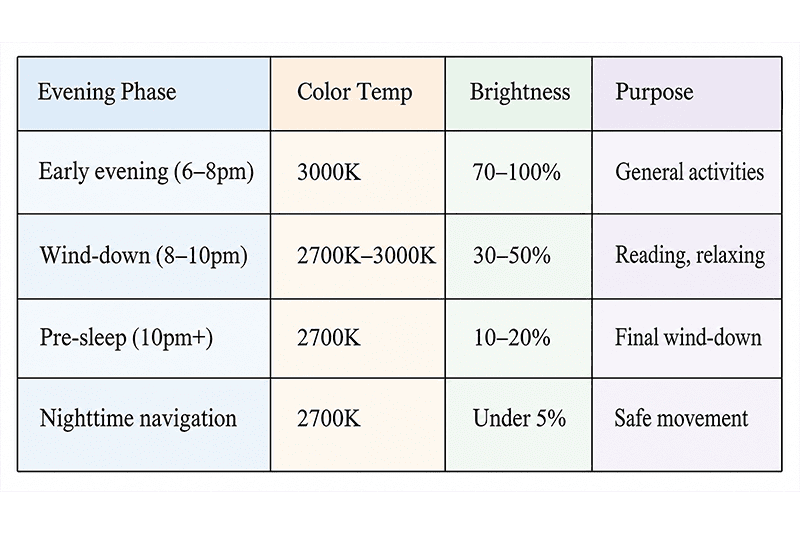
The best bedroom lighting isn't a single warm color temperature. It's a transition — from brighter, functional light early in the evening to softer, warmer light as bedtime approaches. Here's what that looks like in practice:
Early evening (6–8pm): Use your 3000K overhead or ambient lighting at 70–100% brightness. This is your functional window — getting dressed, tidying up, preparing for the next day.
Wind-down (8–10pm): Dim the overhead lights to 30–50%, or switch them off entirely and rely on 2700K–3000K table lamps and floor lamps. Lower levels and warmer tones start supporting your body's natural evening rhythm.
Pre-sleep (10pm+): Keep only a 2700K bedside lamp on at 10–20% brightness. Light should fall on your book, not directly on your face.
Nighttime navigation: If you need light for a bathroom trip, a very low-level 2700K source — like an LED strip under the bed — provides enough visibility without pulling you back into alertness.
You don't need smart bulbs or expensive automation. A layered approach with standard LED products works well:
Layer 1 — Ambient (ceiling): 3000K recessed downlights or a flush-mount fixture, ideally on a dimmer. This is your general-purpose layer for earlier evening hours.
Layer 2 — Task (bedside): 2700K–3000K bedside lamps. Choose fixtures with fabric shades that diffuse and further warm the light.
Layer 3 — Accent (optional): Warm 2700K LED strips behind the headboard or under the bed frame. Gentle enough for nighttime movement, not bright enough to disrupt sleep.
Layer 4 — Elimination: Check for any cool-toned LEDs still in the room — older bulbs, device indicator lights, or anything in the 4000K+ range. These small sources can be more disruptive than people realize.
Each layer corresponds to a different phase of your evening. Together, they create the gradual lighting transition that a single bulb simply can't deliver.
Good bedroom lighting isn't just about warmth — it's about timing, layering, and giving your body the gradual cues it needs. Switching from a single overhead light to a simple layered setup is one of the easiest ways to improve your evening routine, and it costs less than a month of sleep supplements.
At NVC Lighting, we believe better bedroom lighting starts with more than choosing the right bulb. It’s about creating the right combination of color temperature, brightness, and timing for every stage of the evening.

