Have you ever noticed that working under certain lights makes you feel restless — while others leave you too drowsy to focus? It's not a coincidence, and it's not just the brightness. The color temperature of your light could be quietly shaping your mood, energy, and output every single day.
In this article, we break down the difference between 3000K and 6000K lighting, explore the science behind how each affects your brain, and help you figure out which one belongs in your space.
The "K" stands for Kelvin — the unit used to measure color temperature in lighting. It has nothing to do with heat, and everything to do with how warm or cool a light appears to the human eye.
Think of it as a spectrum from "cozy fireplace" to "hospital corridor." Both extremes serve a purpose — but not in the same room, and not for the same task.
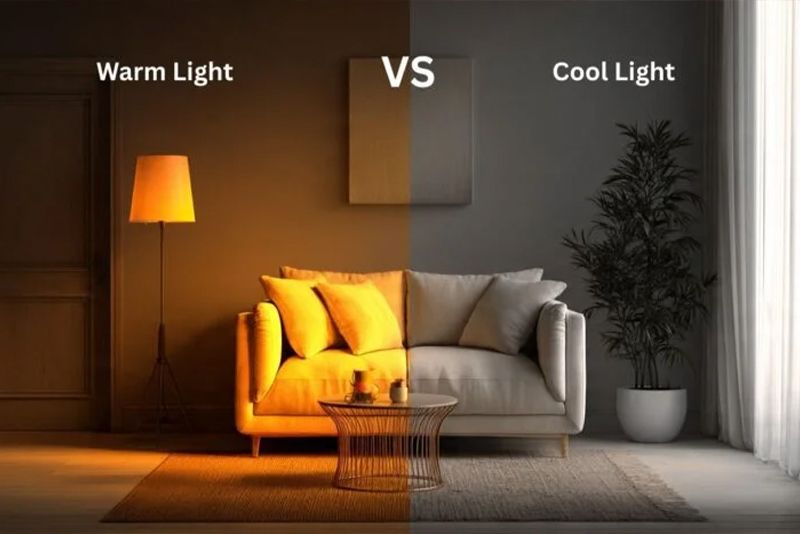
3000K light emits a soft golden tone that immediately signals your brain to slow down. That's a feature — not a flaw — in the right context.
Where it works well:
The downside for productivity: Warm light suppresses alertness. Research on circadian rhythms consistently shows that low-color-temperature light reduces cortisol production and encourages melatonin release — your body's sleep signal. That's great at 10pm. At 10am in a home office? It's working against you.
So if you've been feeling oddly sluggish during your morning work sessions, your "cozy" desk lamp might be part of the problem.
6000K is on the cool, blue-heavy end of the spectrum. It closely mimics natural midday daylight, which is exactly why it tends to increase alertness and mental clarity.
Where it works well:
The anxiety angle: Here's where it gets interesting. While cool light does sharpen focus, overexposure — especially in the evenings or in confined spaces — can elevate cortisol levels and create a low-grade state of physiological stress. Some people describe working under harsh 6000K lighting for long hours as feeling "wired but tired." The light keeps the brain stimulated, but the body gradually accumulates tension.
In other words: 6000K used strategically is a productivity tool. Used carelessly, it becomes a slow-burn stressor.
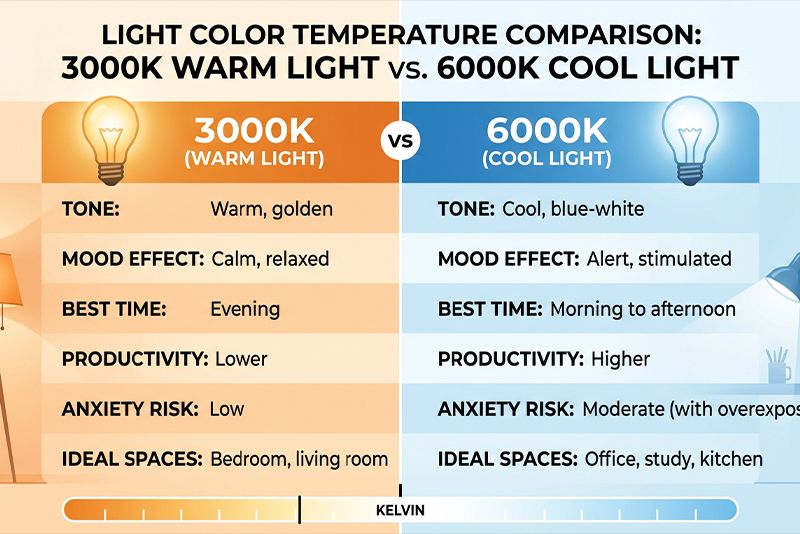
For most people, the answer isn't choosing one over the other — it's using both intentionally.
Modern lighting solutions allow you to shift color temperature throughout the day (often called Human Centric Lighting or tunable white). This mirrors how natural light changes — warm in the morning and evening, cool and bright during peak hours — which keeps your circadian rhythm aligned and your energy levels more stable.
If full tunable lighting isn't in your budget, a practical workaround is to:
This layered approach gives you the best of both temperatures without the downsides of either extreme.
Neither 3000K nor 6000K is inherently "bad." The anxiety and the productivity boosts people associate with these light temperatures are real — but they're responses to context, not fixed traits of the light itself.
The question to ask isn't which is better, but which is better right now, in this space, for this purpose.
Looking to learn more about how warm white lighting shapes your environment? Explore our detailed breakdown: Beyond 3000K Warm White.

