For decades, lighting manufacturers have measured their success through the quality, efficiency, and design of luminaires. However, as LED technology continues to mature and lighting hardware becomes increasingly accessible, the industry is entering a new era. The future of lighting is no longer defined only by the fixture itself, but by the intelligent systems, services, and experiences that lighting can create.
For forward-thinking manufacturers, the key question is changing: how can lighting deliver greater value beyond illumination?
This shift is driving the evolution from traditional lighting products toward smart lighting solutions — connected, adaptive, and sustainable systems designed to improve energy efficiency, building performance, and human experiences.
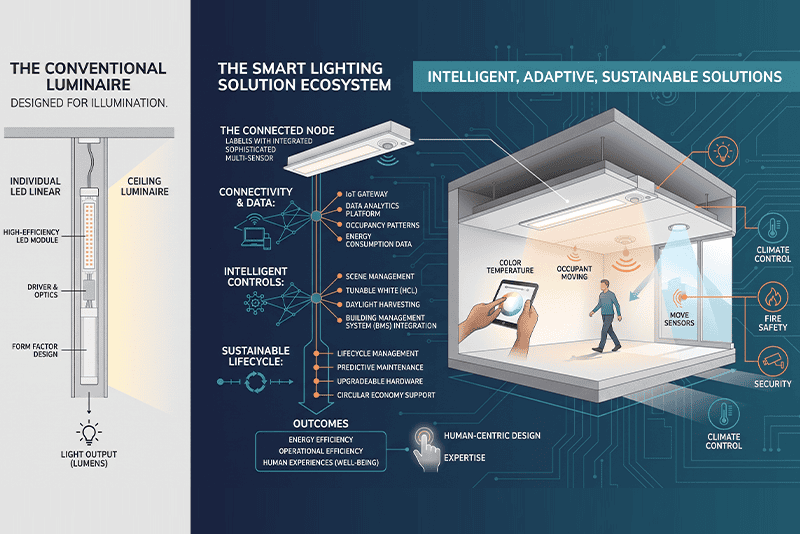
The rapid development of LED technology has significantly improved lighting efficiency while reducing hardware differentiation. Features that once defined competitive advantage — such as brightness, energy efficiency, and form factor — are becoming expected standards rather than unique benefits.
As a result, customers are increasingly looking beyond individual luminaires. They are seeking complete lighting solutions that integrate controls, connectivity, automation, and data-driven insights.
Smart lighting solutions enable lighting systems to respond intelligently to real-world needs. Through sensors, connected controls, and digital platforms, lighting can optimize energy consumption, improve operational efficiency, and create more comfortable environments.
For manufacturers, this represents a fundamental transformation: the value of lighting is moving from the product itself to the outcomes it enables.
One of the most important developments in modern lighting is the integration of connectivity and data.
A connected luminaire is no longer simply a source of light. It can become part of an intelligent building ecosystem — supporting occupancy sensing, energy management, environmental monitoring, and space optimization.
This is where smart lighting solutions create value beyond traditional lighting applications. By connecting lighting systems with building management platforms, businesses can gain greater visibility into how spaces are used and how energy resources are managed.
The future of lighting will not only be about producing better light, but about creating smarter environments where lighting actively supports efficiency, comfort, and productivity.
Sustainability is another major force reshaping the lighting industry. While LED technology has already delivered significant energy savings, the next stage of sustainable development focuses on lifecycle management.
Future-ready lighting systems must consider more than energy consumption. They must also support durability, repairability, upgradeability, and responsible resource management.
Through connected technologies and intelligent monitoring, manufacturers can extend product lifecycles, improve maintenance efficiency, and reduce unnecessary replacement.
This creates a new opportunity for lighting companies to move from one-time product suppliers toward long-term partners providing sustainable lighting solutions.
Lighting is also evolving from a functional necessity into a tool that influences human wellbeing.
Human-centric lighting solutions use advanced controls and tunable technologies to adjust light conditions according to different activities, environments, and biological needs. From improving workplace comfort to supporting healthier indoor spaces, lighting is becoming an essential part of the user experience.
Delivering these outcomes requires more than a high-quality luminaire. It requires a complete approach combining optical design, intelligent controls, system integration, and professional expertise.
This is why the future of lighting belongs to manufacturers that understand both technology and human needs.
It means shifting strategic focus from the physical fixture to the broader value it enables — including connected systems, intelligent controls, lifecycle management, and human-centric lighting outcomes. The luminaire remains essential, but it becomes the foundation of a larger lighting ecosystem rather than the final product itself.
A connected luminaire is no longer simply a source of illumination. Installed throughout buildings, it can support occupancy sensing, environmental monitoring, energy management, and space optimization. By integrating lighting systems with digital platforms, businesses can gain valuable insights to improve operational efficiency and create more intelligent environments.
Sustainable lighting solutions go beyond reducing energy consumption. By combining efficient LED technology, intelligent controls, and lifecycle-focused design, modern lighting systems can improve maintenance efficiency, extend product lifecycles, and support more responsible resource management. This enables lighting manufacturers to become long-term partners in creating more sustainable buildings.

